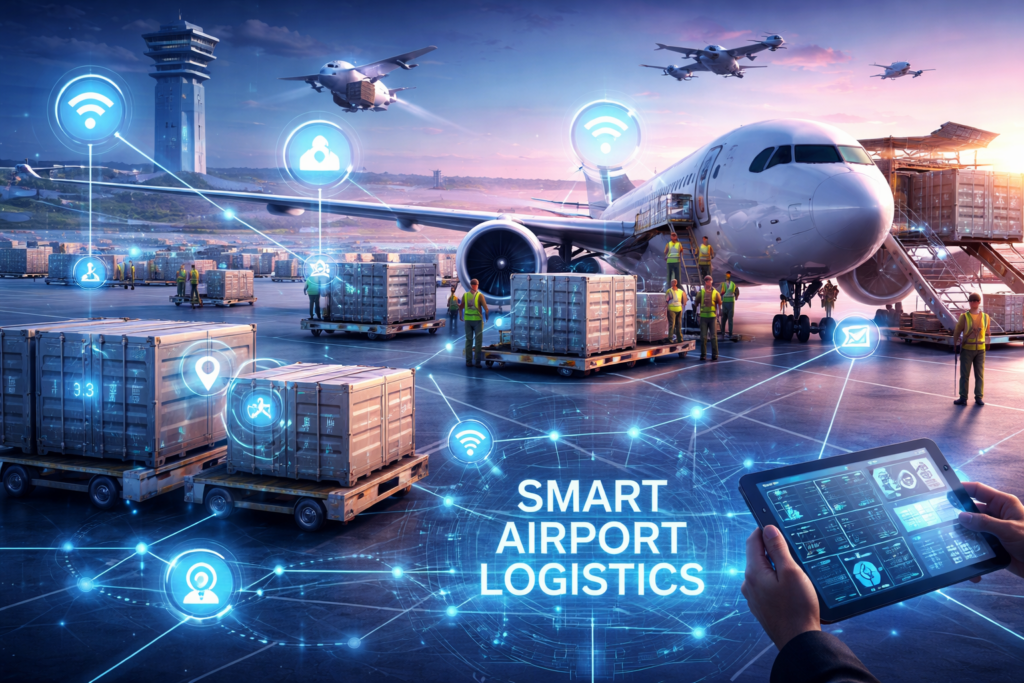
In a globalized world, airport logistics is becoming crucial in the international supply chain. Air freight is now a strategic link facing to the growing demands of an increasingly fast-paced and connected economy.
The global air freight and logistics market is expected to reach nearly USD 243 billion by 2035, with a compound annual growth rate (CAGR) exceeding 12.4% over the period 2026-2035 (Fundamental Business Insights & Consulting, Oct-2025).
In 2025, global freight demand, measured in Cargo Tonne Kilometers (CTK), increased by 4.1%, confirming sustained growth momentum despite macroeconomic constraints (International Air Transport Association (IATA), Sept-2025).
In this context of sustained growth, differentiation is not only based on the transport capacity, but also on mastering real-time data.
👉 This is why IoT becomes a major competitive advantage.
✅ Reduced operational costs with IoT sensors on pallets, ULDs, and ramp equipment to minimize losses and damage (up to 30% depending on usage) and optimize rotations and storage time
➡️ Direct impact on OPEX and cargo profitability
✅ Improved punctuality and service quality with real-time tracking (temperature, shocks, geolocation), critical for pharmaceuticals, perishable goods, and high-value merchandise
➡️ Reduced customer disputes and improved Service-Level Agreement (SLA)
✅ Secured supply chain with IoT, enabling end-to-end traceability, limiting theft, routing errors, and blind spots in airport areas
➡️ Improved regulatory compliance and reduced insurance risks
✅ Data-driver management of airport operations anticipating cargo congestion, ensuring a predictive equipment maintenance, and having more efficient allocation of human and material resources
➡️ Measurable productivity gains (from +10% to +20% on certain hubs)