
In a “still” globalized world where value chains are being reshaped, internationalization remains a key driver of competitiveness and growth for French industries.
However, the facts are not a clear demonstration:
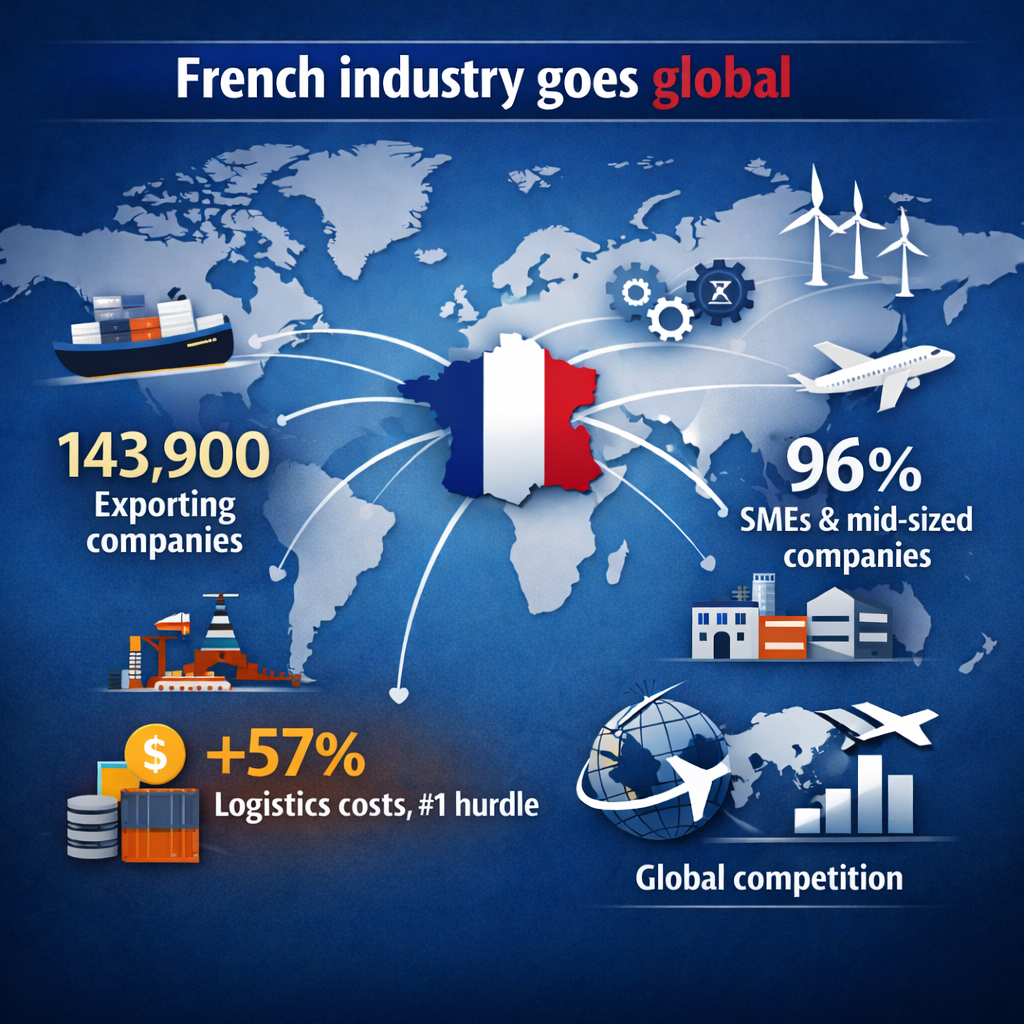
🔴 In 2023, France had 143,900 exporting companies, but this figure declined for the first time since 2017, with 1,800 fewer exporters compared to 2022 : a sign of a certain slowdown in international expansion.
🔴 96% of exporters are SMEs and mid-sized companies, only generating 12% of total export value, while large companies (0.4% of exporters) represent 55% of exported volumes.
🔴 A 2025 study shows that only 37% of companies generate part of their revenue internationally, a significant decline compared to 2024.
Nevertheless, persistent barriers to international development remain:
➡️ High logistics costs, identified as a major concern by 57% of exporting company executives
➡️ International payment risks and delays, cited by nearly 47% of business leaders
➡️ Intense competition in foreign markets, combined with the need for more competitive offerings and a lack of strong commercial strategies
➡️ A large share of exporting SMEs remains focused on the European Union (88%), with only a minority operating beyond it (Americas, Asia).
Despite these challenges, the drive to internationalize remains strong (𝘌𝘴𝘵𝘪𝘷𝘢𝘭 𝘦𝘥𝘪𝘵𝘪𝘰𝘯𝘴 – 𝘕𝘰𝘷𝘦𝘮𝘣𝘦𝘳 2025) :
✅ 54% of executives remain confident about medium-term prospects
✅ 55% of companies already operating abroad plan to strengthen their international activities

👉 As a result, internationalization must be approached as a structured (methodology), long-term strategy, supported by innovation, dedicated resources, and strong local partnerships.