

Yet most executive teams still treat it like a pilot project.
Here’s why that is a strategic mistake :
📊 The market trajectory is unambiguous
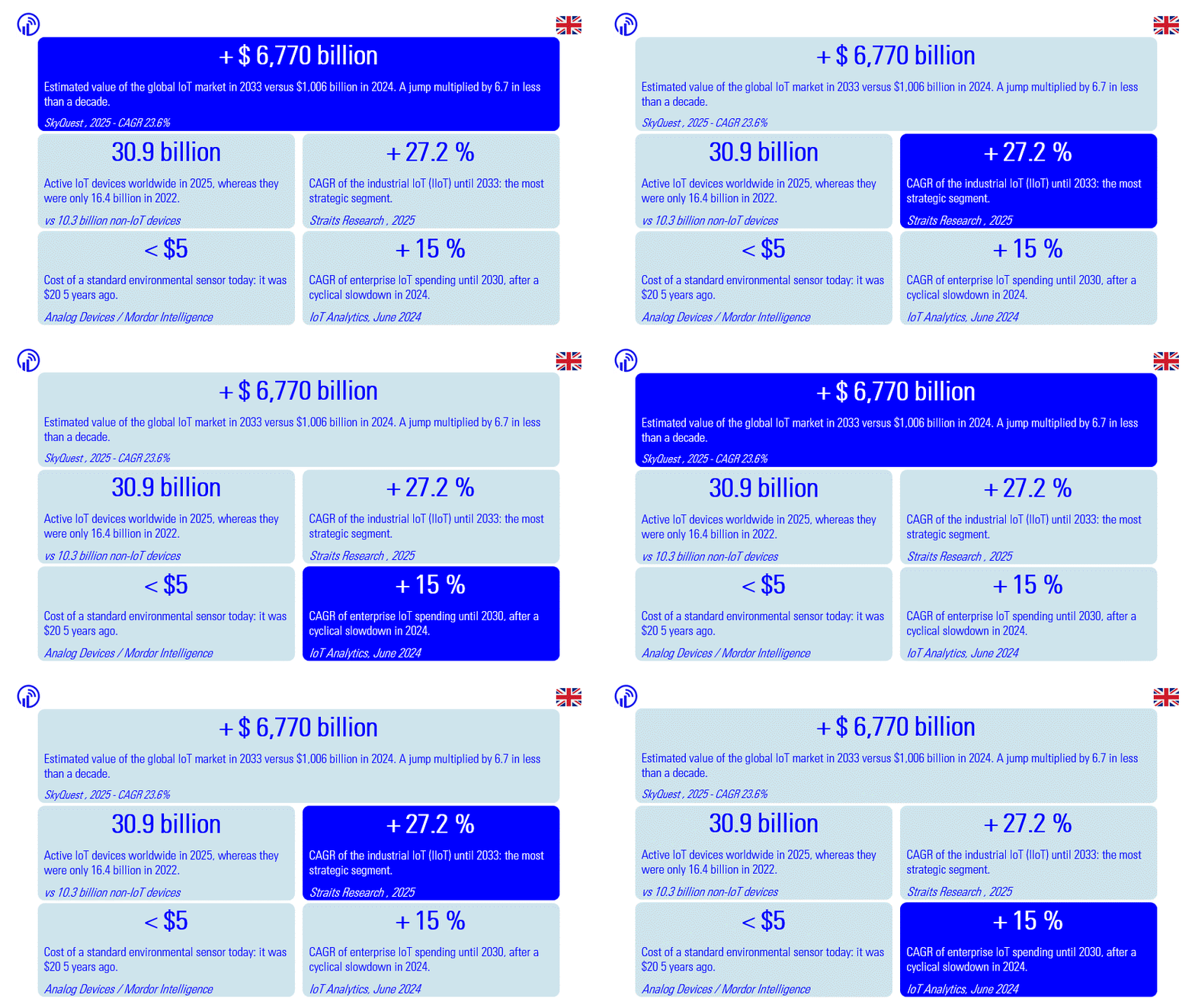
What these numbers really tell us: connected devices now outnumber all “traditional” devices combined. The tipping point happened in 2022. The question is no longer “should we invest in IoT?” but it’s “how much longer can we afford to wait?”
🏛️ Industrial policy has moved first
- + €150M injected by Horizon Europe into Cloud-Edge-IoT programs (2021–2025), with a focus on data sovereignty and digital resilience. The Commission has made interoperability and cybersecurity non-negotiable prerequisites.
- 38.7 million Linky smart meters deployed across France, covering virtually the entire territory. With 25 million connected water meters in rollout, IoT is becoming a state-level infrastructure for the energy transition.
- BACS Decree & Water Plan: regulation now mandates IoT in commercial building management and water network monitoring. This is no longer a strategic choice but it is a legal obligation.
- China, India, United States: IoT spending growth projected at +17%, +14%, and +13% respectively in 2024. The geopolitics of industrial data is being decided right now.
⚡ Innovation signals to watch
- Edge AI: processing is migrating into the device itself. Near-zero latency, stronger data sovereignty, reduced carbon footprint. BMW already runs thousands of sensors over a private 5G network in real time.
- IIoT × Industry 5.0: $180B in 2024 → $4.72T in 2033. Predictive maintenance is now adopted by 75% of industrial companies. General Electric cut maintenance costs by 20% through IoT.
- Cybersecurity & Cyber Resilience Act: every connected device is an attack surface. The EU now mandates security-by-design standards. It is a competitive edge for European players on global markets.
- Cloud-to-Edge Continuum: IoT cloud platforms are growing at a CAGR of +29.5% through 2032. The IoT × AI × cloud convergence is redrawing industrial value chains.
🚨 The adoption gap to close
In 2024, only 22% of French companies used IoT, versus 29% as the European average. And 13% of EU businesses were already combining AI and IoT (Eurostat, 2024).
Europe holds major assets (Schneider Electric, Thales, Siemens, Ericsson) but adoption is still held back by 3 structural barriers: poorly quantified ROI, integration skills shortage, and standards fragmentation.
💬 The real strategic question for 2025–2030
IoT is no longer a technology to test in a lab, it is a national competitiveness lever. The countries and organizations that master the full stack (sensor → edge → platform → sovereign data) will set the rules of the industrial game for the next decade.